
Three sessions. Three green candles. Each one opens near the prior close and drives steadily higher — small upper wicks, strong bodies, no hesitation between them. After a long downtrend, the tape rewrites itself.
That's Three White Soldiers — the most decisive reversal signal in candlestick analysis.
Here's the trade-off. By the third soldier, you know the reversal is real. You've also missed the first three days of the move. Stronger confirmation, later entry. Navigating that tension — when to wait for it, when to move earlier — is what this guide is about.
Three consecutive bullish closes removes doubt. It also removes most of the easy money. That's the trade-off the Three White Soldiers teaches.
What Makes Three White Soldiers
The Three White Soldiers is a three-candle bullish reversal pattern. Each candle has a large real body, opens within or near the prior candle's body, and closes at or near its high. The result is three stair-stepping bullish candles, each one pushing higher than the last.
The name comes from a military metaphor — three soldiers advancing in formation, each one stepping forward with discipline. No straggling. No retreat. The visual is unmistakable: an organized march higher after a period of decline.
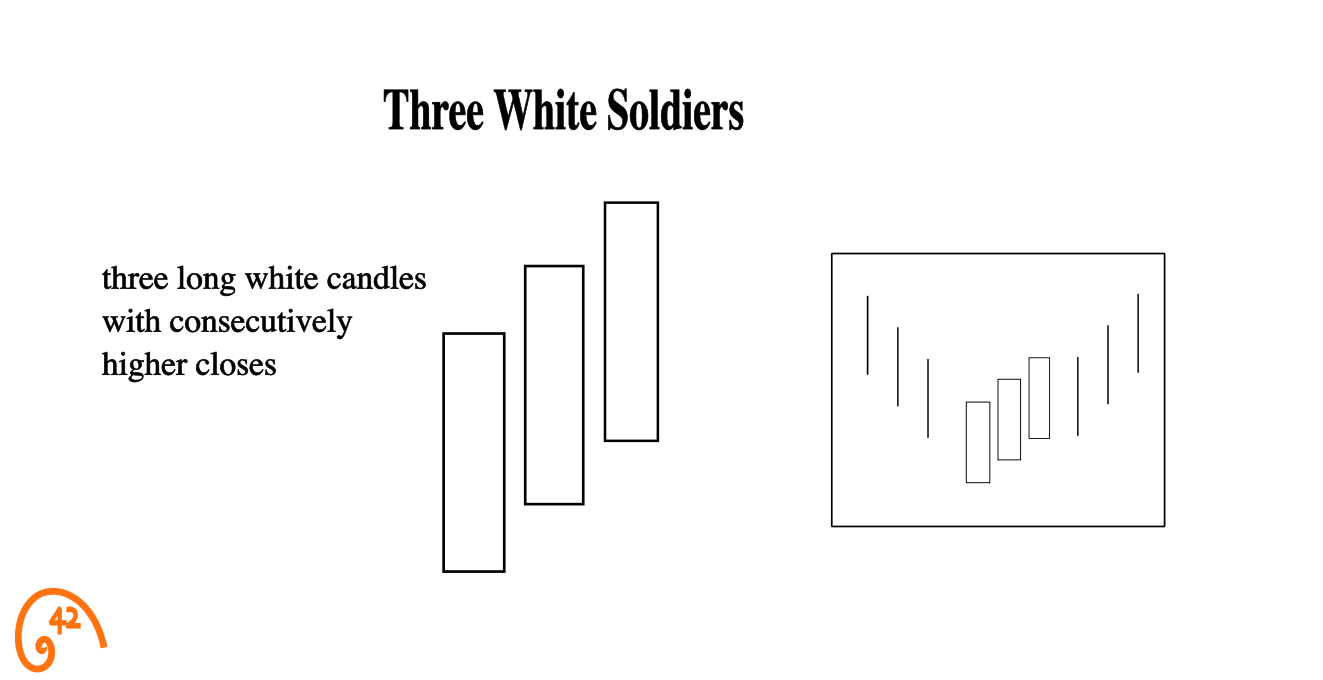
How Three White Soldiers Form
Most patterns compress a story into one or two candles. The Three White Soldiers unfold over three full sessions — and the narrative across those sessions is what gives the pattern its power.
"It bounced. Could be a dead cat — but someone is buying down here."
After a sustained decline, the first strong bullish candle appears at or near support. It could be short covering, institutional accumulation, or just a relief bounce. On its own, it proves nothing — plenty of downtrends produce single green days. But it changes the character of the tape.
"Two in a row. Okay, this isn't random. Buyers are following through."
The second candle opens near the first candle's close and pushes higher again. This is where the pattern starts to differentiate itself from a dead cat bounce. Sellers had overnight to regroup — and they couldn't push price back down. Conviction is building.
"Three straight days of buying. The reversal is real — but I'm three days late."
The third candle confirms the pattern. Three consecutive sessions of buyers in complete control. The downtrend is almost certainly over. But here's the tension: you're now buying at a price that's significantly higher than where the first soldier opened. The signal is clear. The entry is expensive.
This is the fundamental challenge of the Three White Soldiers: the pattern that gives you the most confidence also gives you the worst entry. By the time all three candles have printed, you have near-certainty that buying pressure is real — but you've also watched three days of gains happen without you.
Understanding this dynamic isn't optional. It's the entire point.
Understand the Entry Problem
Most pattern guides treat entry as simple: "Buy after the pattern completes." With the Three White Soldiers, that advice creates a real problem. After three strong bullish candles, you may be buying far above the original support level — with your stop loss still all the way down at the low of the first candle.
That's a wide stop and a lot of risk for a move that's already well underway. So how do experienced traders handle this?
Wait for a pullback after completion
The most disciplined approach. After three strong candles, price often pulls back to retest the breakout zone. That retest gives you a better entry, a tighter stop, and confirmation that the new support level holds. The risk: the pullback may never come if momentum is very strong.
Scale in across the formation
Enter a partial position after the second soldier, and add on the third if it confirms. This gives you a blended entry price better than buying all at the top of candle three. The risk: the second candle isn't full confirmation — you're taking more uncertainty for a better price.
Reduce size to manage the wide stop
If you enter after the third candle with a stop at the first candle's low, the distance is large. Reduce your position size so that if you're stopped out, the dollar loss stays within your risk tolerance. You get the highest-confidence entry but with smaller size.
Soldiers vs. Three Black Crows
The Three White Soldiers has a direct bearish counterpart: the Three Black Crows. Same three-session structure, opposite direction. If you understand one, you already understand the other.
- Appears after a downtrend
- Three consecutive strong bullish candles, each closing near its high
- Signals a potential bottom — buyers in sustained control
- Appears after an uptrend
- Three consecutive strong bearish candles, each closing near its low
- Signals a potential top — sellers in sustained control
The mechanics are identical in both: three sessions of one side fully controlling the tape, with small wicks on the side they're driving against (upper wicks for soldiers, lower wicks for crows). The same trade-off applies in either direction — strong confirmation, but a late entry by the time the third candle prints.
How to Trade Three White Soldiers
Trading the Three White Soldiers requires a different approach than single-candle patterns. The confirmation is built into the pattern itself — three candles of sustained buying is the confirmation. The challenge is managing the entry and risk that come with that built-in delay.
Confirm there's a real downtrend to reverse
The Three White Soldiers only mean something after a sustained decline. Multiple sessions of lower highs and lower lows. A three-day bounce inside a sideways range isn't a reversal — it's noise. The bigger the prior downtrend, the more significant the pattern.
Verify the candle quality
All three candles should have large real bodies and small or no upper wicks, with each opening at or near the prior close. The signal weakens when upper wicks grow long (sellers fighting back), bodies start shrinking (momentum fading), or any candle opens well below the prior close (overnight conviction lost). Small gaps up between candles are fine — they often confirm strength, not weakness.
Check what the pattern reclaims
The strongest Three White Soldiers patterns reclaim key levels during the advance — the 21-EMA, the 50-day MA, or a prior support-turned-resistance level. If the pattern pushes through meaningful structure, it's not just price action — it's buyers taking back territory.
Choose your entry approach
You have three options: enter after the third candle closes (highest confidence, worst entry), scale in during the formation (moderate confidence, better average price), or wait for a pullback after completion (best entry, risk of missing the move). Pick the one that fits your risk tolerance.
Define your stop and manage position size
The natural stop is below the low of the first candle — that's where the pattern started and where the setup fails. If that distance is too wide for your risk tolerance, reduce size. Never widen your risk budget to accommodate a pattern — adjust your position instead.
Three consecutive strong bullish candles just completed after a downtrend. The pattern is textbook Three White Soldiers — minimal upper wicks, progressive closes. But the stock has already rallied 12% from the low. RSI is at 68. Your usual position size would put the stop (below candle 1's low) at a 7% risk.
How do you handle a confirmed signal with a poor entry?
Reading Three White Soldiers in Context
Three lenses decide whether Three White Soldiers are a real reversal or just a relief rally: volume, structure, and momentum. Each gets its own dedicated guide; this is the quick orientation.
Volume — are the soldiers gaining reinforcements or running out? The cleanest pattern shows steady or rising volume across the three sessions — each day more participants joining the advance. Declining volume across the three candles is a warning: price is climbing, but fewer hands are driving it. That's a setup that often gives back ground once the first buyers start taking profits. Read the Candlesticks + Volume guide →
Structure — what did the soldiers reclaim? Three strong sessions push price meaningfully above the level where the pattern began. If the advance also pushed through a moving average, a prior support-turned-resistance, or a Fib retracement, those levels now become structure for the next pullback — and your entry has somewhere to lean. If the soldiers march through open air with no structure reclaimed, the third-candle entry is just a guess on momentum. Read the Candlesticks + Moving Averages guide →
Momentum — where is RSI by the time the pattern completes? Three consecutive bullish sessions push RSI sharply higher. If RSI was deep in oversold territory before the pattern started, the move likely still has room — momentum is just resetting from stretched levels. If RSI is already pushing toward 70 by the third candle, you're entering when the easy part of the move is already behind you. Check RSI both before and after the formation: oversold-to-neutral is a healthier entry than neutral-to-overbought. Candlesticks + RSI guide →
Pattern tells me where to look, context tells me whether to act.
Seeing Three White Soldiers in Action: $WMT
Here's a Three White Soldiers that arrived at structure and resolved the timing trade-off cleanly — no chase required.
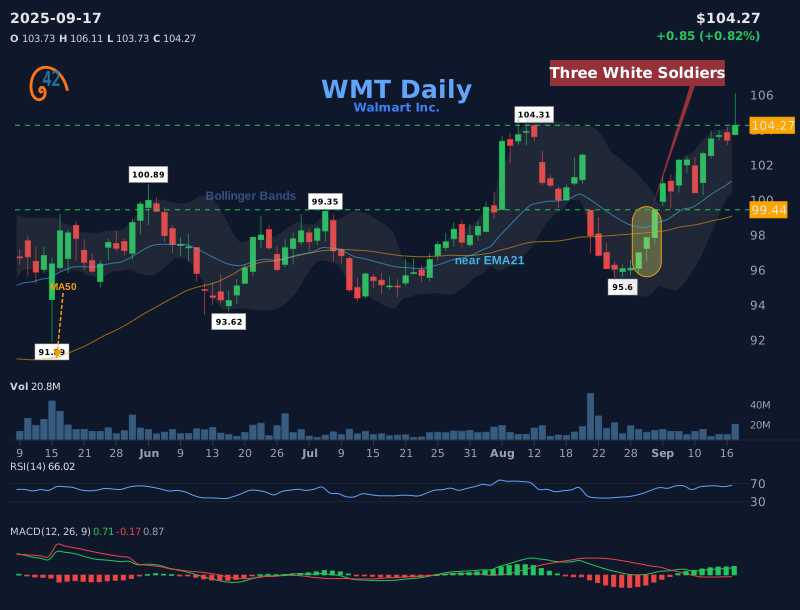
Before the soldiers. Walmart ($WMT) peaked near ~$104 in mid-August 2025, then drifted into the ~$95 support zone by late August — a grinding, multi-session decline, not a panic. As price drifted lower, several Spinning Tops appeared: small bodies with wicks on both sides, sellers losing momentum without buyers stepping in yet.
The soldiers print. Right at that ~$95 level, three consecutive strong bullish candles erupted in early September. Each opened near the prior close, closed near its high, with small upper wicks. The advance pushed through the 21-EMA and reclaimed the 50-day MA in the process — the reclaim is what turned the hesitation into a confirmed reversal.
The next sessions. Price held the ground the soldiers took. The 21-EMA, freshly reclaimed, behaved like support on the small pullbacks that followed. There was no immediate retest of $95.
Why this one was tradeable. Real downtrend (multi-week pullback from ~$104), meaningful level (~$95 support), structure reclaimed during the formation (21-EMA + 50-day MA), clean candle quality (small upper wicks, each close at or near the high). The bullish trend resumed into late September toward the prior ~$104 peak.
Common Three White Soldiers Mistakes
The Three White Soldiers is one of the most visually compelling patterns — three strong green candles are hard to ignore. That visual impact is also what leads to the most common mistakes.
Three green candles! The reversal is confirmed — buy at any price.
By candle three, a significant move has already happened. Evaluate the risk-to-reward from your actual entry price, not from where the pattern started. If the stop is too wide and the target too close, wait for a pullback.
Three bullish candles stacked — that's the signal, full stop.
Inside a sideways drift or on top of an existing uptrend, three green bars aren't turning anything. They're rhythm, not a pivot. The pattern earns its name only when it erases a real period of selling that had sentiment genuinely bearish.
The bodies are green and rising — whatever happens above the close is irrelevant.
A wick stretched above a small body tells you buyers sprinted intraday and handed back ground before the bell. Soldiers that march cleanly leave almost nothing on top; when every candle gives back a chunk, sellers are still very much in the fight even as the closes print higher.
A stop near the third candle's low keeps my loss small — problem solved.
That level will get hit by ordinary intraday wobble and exit a trade the pattern hasn't actually broken. The thesis doesn't fail until price closes back under Candle 1's low. If respecting that reality blows out your risk budget, the correct lever is share count — not the stop price.
The pattern is three candles. Volume is secondary.
Volume across the three candles tells you whether the advance has participation. Declining volume across the formation — each candle with less volume than the last — suggests the soldiers are running out of reinforcements.
- The Three White Soldiers is the most decisive reversal signal — three consecutive sessions of buyer control after a decline
- Upper wicks matter: ideal soldiers close at or near their highs with minimal upper shadows
- The core trade-off is certainty vs. entry price — the strongest confirmation comes with the worst risk-to-reward
- Manage the entry problem through position sizing, scaling in, or waiting for a pullback after completion
- Volume should be steady or increasing across the three candles — declining volume is a warning
- The pattern must follow a real downtrend — three green candles in a range are not a reversal
- The natural stop is below the first candle's low — if that's too wide, reduce size rather than tighten the stop to an invalid level
Frequently Asked Questions
Is it too late to buy after the third candle?
Not necessarily, but the entry is more expensive than it was three days ago. After the third candle, you have high confidence the reversal is real — but you also have a wider stop and a less favorable risk-to-reward. Consider waiting for a pullback, scaling in during formation, or reducing position size.
What should the upper wicks look like?
As small as possible. Ideal Three White Soldiers close at or very near their session highs, leaving minimal upper wicks. Long upper wicks indicate sellers pushed price back down from the highs before the close — meaning the advance is being contested. Long upper shadows significantly weaken the signal.
What is the difference between Three White Soldiers and a Morning Star?
Both are three-candle bullish reversal patterns, but the structure is completely different. A Morning Star has a bearish first candle, a small indecision candle in the middle, and a bullish third. Three White Soldiers have three consecutive bullish candles — the reversal happens through sustained buying, not through hesitation.
How important is volume for this pattern?
Volume progression across the three candles is important context. Ideally, volume is steady or increasing — each session has equal or greater participation. Declining volume across the formation (each candle lower volume than the last) is a warning that the advance may lack broad participation, even though price keeps rising.
Where should I place my stop loss?
Below the low of the first candle in the formation. That is where the entire pattern began and where the reversal thesis fails. Placing a stop tighter risks getting stopped out by normal fluctuation. If the distance creates too much risk, reduce your position size rather than using an invalid stop level.
Can the Three White Soldiers appear in an uptrend?
Three consecutive bullish candles can appear anywhere, but they only qualify as a Three White Soldiers reversal pattern when they follow a downtrend. In an uptrend, three bullish candles in a row are just trend continuation — not a pattern with special significance. Context determines meaning.
The Bottom Line
The Three White Soldiers teaches the hardest trade-off in trading: the most reliable signals often come with the worst entries. Three consecutive bullish sessions leave no doubt about buyer conviction — but they also mean you're arriving after three days of gains.
Learning to manage that tension — through position sizing, partial entries, or patience for pullbacks — is the skill this pattern develops. It's not about whether the reversal is real. With Three White Soldiers, it almost always is. It's about whether the trade is still worth taking from where you're standing.
When you see Three White Soldiers after a clear decline, at a meaningful support level, with steady or increasing volume and reclaimed moving averages — you're looking at one of the most decisive reversal signals in candlestick analysis. The question isn't whether to believe it. It's how to position for it.
Our 42Fibonacci Scanner checks for these conditions automatically across 3,000+ stocks.
Find Three White Soldiers setups in the scanner →In this guide
'%3e%3crect%20width='240'%20height='240'%20fill='%23FF7A00'%3e%3c/rect%3e%3cg%20transform='matrix(0.07095%200%200%20-0.07095%2015%20220.748)'%20fill='%23FFFFFF'%20stroke='none'%3e%3cpath%20d='M1365%202583%20c-628%20-81%20-1087%20-602%20-1111%20-1258%20-9%20-231%2023%20-399%20111%20-580%20207%20-427%20651%20-631%20900%20-414%20313%20274%2067%20875%20-305%20744%20-177%20-63%20-242%20-307%20-110%20-418%2098%20-83%20230%20-43%20230%2069%200%2047%20-5%2051%20-34%2029%20-55%20-42%20-117%204%20-100%2073%2020%2082%20131%20108%20196%2046%2074%20-71%20100%20-207%2058%20-316%20-65%20-174%20-281%20-266%20-437%20-185%20-146%2075%20-276%20272%20-340%20515%20-34%20128%20-39%20396%20-10%20532%20103%20479%20422%20837%20856%20958%20143%2040%20402%2039%20536%20-1%20434%20-132%20743%20-484%20841%20-959%2019%20-91%2024%20-295%2011%20-413%20-11%20-91%20-2%20-80%2029%2041%2080%20312%2017%20689%20-163%20972%20-253%20397%20-715%20623%20-1158%20565z'%3e%3c/path%3e%3cpath%20d='M2035%201809%20c-63%20-18%20-121%20-85%20-140%20-161%20-6%20-23%20-3%20-27%2027%20-33%2018%20-3%2040%20-9%2050%20-11%2011%20-3%2018%203%2023%2023%2025%20113%20189%20126%20225%2018%2031%20-93%20-7%20-155%20-243%20-409%20-86%20-92%20-88%20-96%20-85%20-138%20l3%20-43%20223%20-2%20222%20-3%200%2045%20c0%2025%20-1%2048%20-2%2053%20-3%207%20-22%208%20-191%2011%20l-98%201%2075%2083%20c167%20181%20210%20263%20204%20379%20-8%20148%20-140%20232%20-293%20187z'%3e%3c/path%3e%3cpath%20d='M1579%201733%20c-29%20-43%20-106%20-154%20-171%20-247%20-107%20-152%20-118%20-173%20-118%20-212%20l0%20-44%20173%20-2%20172%20-3%203%20-88%203%20-89%2052%204%20c32%202%2052%208%2053%2016%201%206%202%2046%203%2087%20l1%2075%2045%200%2045%200%200%2050%200%2050%20-45%200%20-45%200%20-1%20173%20c-1%2094%200%20202%201%20240%20l2%2067%20-60%200%20-60%200%20-53%20-77z%20m58%20-400%20c-3%20-2%20-52%20-2%20-110%20-1%20l-105%203%20107%20155%20106%20155%203%20-154%20c1%20-85%201%20-156%20-1%20-158z'%3e%3c/path%3e%3c/g%3e%3c/g%3e%3c/svg%3e)
42Fibonacci