📘 How to Trade Candlesticks With RSI
By 42Fibonacci • Last Updated: 2025-12-18 • 10–12 min read
Part of the 42Fibonacci Candlestick Education Series
Introduction: Why Candlesticks Alone Are Not Enough
Candlestick patterns show how price moved within a session — where buyers and sellers pushed, hesitated, or stalled.
If you’ve read our guide on Candlestick Charts: The Complete Beginner’s Guide, you already understand how candle bodies and wicks reflect short-term price behavior. That foundation is essential.
But candlesticks alone leave an important question unanswered:
How stretched or balanced is the current move?
This is where the Relative Strength Index (RSI) becomes useful.
Rather than predicting reversals or acting as a timing tool on its own, RSI helps place candlestick patterns within a momentum and exhaustion context — clarifying whether price is extended, stabilizing, or resetting.
This article explains how to use RSI as a supporting layer, not a signal generator, when evaluating daily candlestick patterns.
What Is RSI
The Relative Strength Index (RSI) is a momentum oscillator that measures the speed and magnitude of recent price changes.
RSI does not measure trend direction directly.
Instead, it helps describe how aggressively price has been moving over a recent window of time.
How RSI Is Calculated (Conceptually)
RSI compares the size of recent gains to recent losses over a fixed number of periods.
In simple terms:
- stronger and more frequent gains push RSI higher
- stronger and more frequent losses push RSI lower
- balanced movement keeps RSI near the middle of its range
The result is a normalized value between 0 and 100, allowing momentum to be compared consistently across different stocks and time periods.
This article avoids the full mathematical formula because the interpretation, not the arithmetic, is what matters most for candlestick analysis.
Common RSI Settings
RSI is commonly calculated using different lookback periods, each emphasizing a different sensitivity:
- RSI 14 — the most widely used standard, balancing responsiveness and stability
- RSI 9 — more sensitive, reacts faster to short-term price changes
- RSI 21 — smoother, slower to respond, often used for higher-level context
Shorter RSI periods respond quickly but produce more noise.
Longer periods smooth fluctuations but react more slowly.
RSI Default Used in This Article
To keep analysis consistent and comparable, this article assumes:
- RSI 14
- calculated on daily charts
Unless stated otherwise, any reference to RSI levels, behavior, or examples refers to RSI 14.
RSI is not treated as a predictive tool or a signal generator.
It is used strictly as context to help evaluate how candlestick patterns form within recent momentum conditions.
What RSI Does (and Does Not Do)
What RSI Does
- Describes momentum intensity
- Highlights potential exhaustion or stabilization
- Adds context to candlestick patterns
- Helps filter low-quality setups
What RSI Does Not Do
- Predict reversals
- Guarantee entries or exits
- Replace price action
- Work well in isolation
RSI is most effective when it supports what price is already showing, not when it contradicts it.
Common RSI Levels (and Why 70 / 30 Are Used)
RSI is commonly associated with two reference levels:
- Above 70 → often labeled overbought
- Below 30 → often labeled oversold
Why RSI Above 70 Is Called “Overbought”
RSI rises when recent gains consistently outweigh recent losses.
When RSI moves above 70, it indicates that:
- price has advanced rapidly relative to its recent history
- buying pressure has been dominant for an extended stretch
- short-term momentum is stretched, not necessarily exhausted
The term overbought does not mean:
- price must reverse
- buyers are finished
- a sell signal is present
It simply means that price has moved faster than usual, increasing the likelihood of pauses, pullbacks, or consolidation — especially if momentum begins to slow.
In strong uptrends, RSI can remain above 70 for long periods without price reversing.
Why RSI Below 30 Is Called “Oversold”
RSI falls when recent losses consistently outweigh recent gains.
When RSI drops below 30, it suggests that:
- selling pressure has been aggressive
- price has declined rapidly relative to recent history
- downside momentum is extended, not necessarily complete
The term oversold does not mean:
- price must bounce
- sellers are finished
- a buy signal is present
It indicates that price has moved sharply downward, increasing the chance of stabilization — not guaranteeing a reversal.
In strong downtrends, RSI can remain below 30 for extended periods.
How These Levels Should Be Interpreted
RSI levels describe momentum conditions, not outcomes.
- Above 70 → momentum is strong and potentially stretched
- Below 30 → momentum is weak and potentially stretched
Whether price reverses, pauses, or continues depends on price structure, not RSI alone.
For this reason, RSI levels are best used to contextualize candlestick patterns, not to replace them.
Candlestick Patterns Forming With RSI Below 30
When RSI (14) falls below 30, it indicates that selling pressure has been strong and sustained relative to recent history.
This condition does not mean price must bounce or reverse.
It simply shows that downside momentum has already been stretched, making further acceleration less certain than earlier in the move.
Candlestick patterns that form while RSI is below 30 are best interpreted as:
- potential pauses in selling pressure
- early signs of stabilization
- moments where downside momentum may no longer be intensifying
—not as automatic reversal signals.
From a price-action perspective, an RSI reading below 30 describes an environment where downside pressure has already been heavily expressed.
When a bullish reversal candlestick forms under these conditions, it suggests that further selling is no longer being accepted at lower prices. In practical terms, downside momentum encounters resistance, even if a broader trend change has not yet occurred.
This shift does not guarantee a sustained reversal. However, it often coincides with short-term rebalancing behavior — such as reduced selling urgency or position adjustments — which can support a temporary recovery or relief move.
The key takeaway is not that RSI below 30 predicts higher prices, but that it helps explain why a bullish reversal pattern may carry more relevance after selling pressure has already been stretched.
Example: Bullish Harami Forming in an Oversold Environment ($LLY)
Our scanner identified a Bullish Harami in $LLY on 2025-08-09, forming after a decline while RSI (14) had remained below 30 for several sessions before it.
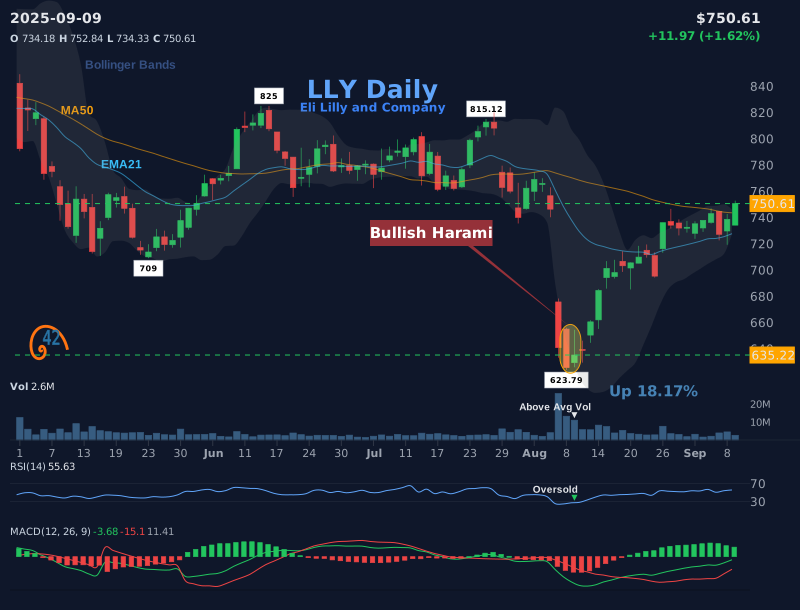
At the time the pattern formed:
- downside momentum had already been aggressive
- RSI reflected a clearly oversold environment
Following the Harami:
- price stopped making new lows
- subsequent candles pushed higher
- RSI gradually recovered toward a more balanced level near 50
When the Bullish Harami formed under oversold environment, it suggested that additional selling was no longer being accepted at lower prices. In other words, the candle mattered not because RSI predicted a reversal, but because the oversold environment made this pause in selling pressure more relevant.
As price stabilized and moved higher in the sessions that followed, RSI naturally recovered toward the middle of its range, reflecting the change in price behavior.
This example illustrates how RSI ≤ 30 helps identify an oversold environment where a bullish candlestick pattern can become more relevant.
A Practical Mental Model
Instead of asking:
“Is this a bullish candlestick pattern?”
Ask:
- What has momentum been doing recently?
- Is momentum still accelerating, or stabilizing?
- Does this candlestick pattern align with that momentum behavior?
This shift moves RSI from a trigger to a context filter.
Final Takeaway
RSI does not make candlestick patterns work.
It helps you understand when they are more likely to struggle or breathe.
Candlesticks describe price behavior.
RSI describes momentum behavior.
Used together, they improve context — not certainty.
If you’d like to explore how candlestick patterns behave in oversold environments, you can review the following section on 42Fibonacci: