📘 Spinning Top
By 42Fibonacci • Last Updated: 2025-12-10 • 7–9 min read
Part of the 42Fibonacci Candlestick Education Series
What Is a Spinning Top?
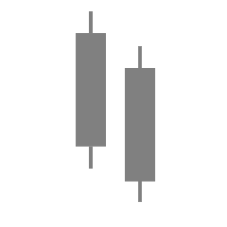
A Spinning Top is a candlestick pattern that reflects active trading followed by indecision. It forms when the open and close are close together, creating a small real body, while upper and lower shadows extend beyond the body, showing that price moved in both directions during the session.
The Spinning Top is closely related to the Long-Legged Doji, but the key difference lies in the body size. While a Long-Legged Doji has a near-zero body — with the open and close virtually identical — a Spinning Top retains a small but visible real body. This difference matters because a Spinning Top suggests hesitation with a slight edge for one side, whereas a Long-Legged Doji reflects complete equilibrium between buyers and sellers.
Spinning Tops are most meaningful when they appear:
- After a strong uptrend or downtrend
- Near important support or resistance levels
- As momentum begins to slow
In these contexts, the Spinning Top signals a pause in control — a market that is no longer moving decisively and is waiting for confirmation before choosing its next direction.
NOTE
The color of the Spinning Top’s body is not important.
Its significance comes from context and follow-through, not from the candle alone.
Origin of the Pattern
The pattern resembles a spinning top toy, with a small body at the center and long shadows on both sides.
This visual perfectly matches its psychological message: the market is spinning without direction, waiting for the next decisive push.
The Psychology Behind the Spinning Top
The Spinning Top represents a session where both buyers and sellers are active, but neither side can establish dominance. Throughout the day, price moves higher and lower as both sides attempt to push the market in their favor. These intraday battles create the long shadows above and below the candle.
Despite this activity, the session ends near where it began. The small real body reflects hesitation — a sign that conviction is fading. Buyers are no longer able to push prices decisively higher, and sellers are unable to force a sustained decline.
When a Spinning Top forms after an uptrend, it often signals that bullish momentum is weakening and that buyers are becoming cautious.
When a Spinning Top forms after a downtrend, it can indicate that selling pressure is losing effectiveness as buyers begin to step in.
In both cases, the Spinning Top marks a pause in momentum. The market is no longer moving smoothly in one direction; instead, it is reassessing. This pause often precedes either a continuation with renewed strength or a reversal once confirmation appears.
How to Trade the Spinning Top (The Right Way)
Quick read: Use Spinning Tops only after a clear trend, prefer them at key support/resistance or MAs, wait for the next candle to confirm direction, and anchor risk to nearby structure.
The Spinning Top is not a directional signal. It is a warning of hesitation, telling traders to slow down and wait for the market to reveal intent.
Focus on Trend and Location
The pattern is most meaningful when it appears:
- After a strong, extended trend
- Near well-defined support or resistance
- Following a period of directional momentum
In sideways markets, Spinning Tops are common and usually insignificant.
Let the Next Candle Confirm Direction
Because the Spinning Top reflects indecision, the next candle provides clarity.
- A bullish confirmation after a Spinning Top near support suggests buyers are regaining control.
- A bearish confirmation after the pattern near resistance signals sellers may be taking over.
Without follow-through, the market may remain range-bound.
Use Nearby Structure for Risk Management
Spinning Tops do not provide a single obvious invalidation level, so traders should rely on nearby support and resistance.
- For bullish setups, recent swing lows or demand zones help define risk.
- For bearish setups, recent highs or supply areas act as logical invalidation points.
Clear structure is essential when volatility increases.
Look for Confluence
The reliability of a Spinning Top improves when supported by:
- Volume changes that confirm participation
- Momentum indicators flattening or diverging
- Interaction with moving averages, trendlines, or prior consolidation zones
Confluence helps separate meaningful pauses from random noise.
Case Study: Spinning Top at a Momentum Turning Point
Quick read: After breaking down from a $390–$363 consolidation and sliding into late July, $HCA printed a Spinning Top near the 200-day MA on elevated volume; that pause in momentum resolved into a 6-bar bullish reversal.
Timeline
- Mid May – Late June: $HCA consolidates between ~$390 and ~$363, forming a clear range.
- Late June – Late July: Price breaks down from the range and trends lower, establishing a clear short-term downtrend.
- Late July (signal day): A Spinning Top prints near the 200-day MA on elevated volume.
- Following sessions: Buyers step in, producing a 6-bar bullish advance.
The Signal
- After a sustained decline, a Spinning Top printed — a small real body with long upper and lower wicks — signaling indecision and a loss of directional control.
- The following session closed above the Spinning Top’s range, confirming that buyers were beginning to take control.
Context
- Prior consolidation between $390–$363 created a well-defined structure before the breakdown. The subsequent slide into late July produced a mature downtrend.
- MA200 Support: The Spinning Top printed directly at the 200-day moving average, a widely watched long-term support level.
- Volume Expansion: Trading volume increased on the signal candle, indicating active participation rather than a low-liquidity pause.
- Momentum Exhaustion: RSI was oversold, suggesting downside momentum was stretched and vulnerable to reversal.
What Happened
- Sellers failed to press the breakdown further.
- Buyers gained control in the sessions that followed, driving a 6-bar bullish reversal, confirming that downside momentum had stalled.
TIP
Quick checklist: established prior trend, small real body with meaningful wicks, forms at support or a key MA, signs of momentum exhaustion (RSI/volume), and at least one confirming bullish bar.
Common Mistakes Traders Make With Spinning Top
Quick read: Don’t treat a single Spinning Top as a buy/sell, ignore it in choppy environment, wait for the next bar to confirm, and use trend/location/volume to decide if it matters.
Spinning Tops are subtle candles, and their ambiguity is exactly why they are often misunderstood. Many traders misinterpret them as direct buy or sell signals, when in reality they are warning signs, not instructions.
Treating a Spinning Top as a Standalone Signal
A Spinning Top does not indicate direction by itself. Acting on the candle alone — without waiting for confirmation — often leads to premature entries and false signals.
The candle is saying “momentum is slowing”, not “price is about to reverse right now.”
Ignoring the Trend Context
A Spinning Top means very different things depending on where it appears.
- In a strong uptrend, it may signal buyer fatigue
- In a strong downtrend, it may signal seller exhaustion
- In a sideways market, it often means nothing at all
Failing to evaluate the surrounding trend turns a useful warning sign into noise.
Confusing Spinning Tops With Dojis
Although both patterns signal indecision, they are not the same.
A Spinning Top has a small real body, meaning one side still managed to finish slightly ahead.
A Doji reflects complete balance, where neither side gained ground.
Mistaking one for the other can lead traders to overestimate or underestimate the strength of the signal.
Overreacting to a Single Candle
One Spinning Top does not invalidate an entire trend.
Traders often exit strong positions too early because they interpret a single indecision candle as a guaranteed reversal. Without confirmation from the following candle or broader structure, the trend may simply resume.
Ignoring Volume and Volatility
A Spinning Top on low volume may reflect a quiet session rather than genuine indecision. Conversely, a Spinning Top formed on elevated volume shows real disagreement between buyers and sellers and deserves more attention.
Volatility also matters — identical candles can carry very different meaning in calm versus fast-moving markets.
Failing to Define Invalidation
Every candlestick setup requires a point where the idea is proven wrong.
Traders often enter trades based on a Spinning Top without defining where the signal fails. Without clear invalidation levels, small hesitation signals can lead to disproportionately large losses.
Summary: Indecision After Effort Deserves Attention
The Spinning Top highlights moments when both buyers and sellers are active, yet neither can take control. It reflects hesitation, fading momentum, and a market that is reassessing direction.
When the pattern appears after a strong trend or near key levels, it can serve as an early warning that conditions are changing. However, confirmation is always required to determine whether the market will reverse or continue.
By respecting context, waiting for follow-through, and managing risk carefully, traders can use the Spinning Top to recognize important pauses before the market commits to its next move.
Explore Spinning Top setups using our tools:
Treat indecision as information — and let the market decide the direction.