📘 How to Trade Candlesticks With Moving Averages
By 42Fibonacci • Last Updated: 2025-12-19 • 10–12 min read
Part of the 42Fibonacci Candlestick Education Series
Introduction: Why Candlesticks Alone Are Not Enough
Candlestick patterns show how price behaved within a session — who pushed, who defended, and where the battle paused or shifted.
If you’ve already read our guide on Candlestick Charts: The Complete Beginner’s Guide, you understand how candle bodies and wicks reflect short-term control between buyers and sellers. That foundation is essential.
But candlesticks alone leave one critical question unanswered:
Where is this battle taking place within the broader trend?
This is where moving averages come in.
Rather than predicting price or acting as standalone signals, moving averages provide structural context — helping traders understand whether a candlestick pattern is forming:
- with the trend,
- against the trend, or
- at a key area of balance.
This article focuses on how to combine candlestick patterns with moving averages to improve signal quality, reduce false reversals, and trade with clearer market structure — without overcomplicating the chart.
What Are Moving Averages
A moving average (MA) is a technical indicator that smooths price data over time to help traders identify trend direction and market structure, rather than reacting to short-term fluctuations.
Instead of focusing on individual candles, moving averages answer broader questions such as:
- Is price trending up, down, or moving sideways?
- Where has price historically found support or resistance?
- Is momentum strengthening or fading?
There are two primary types of moving averages used in candlestick analysis: Simple Moving Averages (SMA) and Exponential Moving Averages (EMA).
Simple Moving Average (SMA)
A Simple Moving Average (SMA) calculates the average closing price over a fixed number of periods, giving equal weight to each candle.
For example:
- A 50-day SMA averages the last 50 daily closes
- A 200-day SMA averages the last 200 daily closes
Because SMAs respond more slowly to price changes, they are commonly used to:
- define intermediate and long-term trends
- identify major support and resistance zones
- distinguish bullish vs bearish market regimes
Commonly Used SMAs
- SMA 50 — intermediate trend and pullback structure
- SMA 200 — long-term trend and regime boundary
These averages are widely followed and often act as self-reinforcing reference levels due to collective market attention.
Exponential Moving Average (EMA)
An Exponential Moving Average (EMA) also averages price over time, but it places greater weight on recent candles, allowing it to respond more quickly to price changes.
Because of this sensitivity, EMAs are commonly used to:
- track short-term trend direction
- evaluate pullbacks within an existing trend
- assess near-term momentum shifts
Commonly Used EMA
- EMA 21 — short-term trend and dynamic pullback reference
The EMA 21 often acts as a guideline rather than a strict level, helping traders judge whether momentum remains intact during retracements.
Moving Average Defaults Used in This Article
To keep the analysis focused and consistent, this article uses the following daily moving averages:
- EMA 21 — short-term trend and pullback context
- SMA 50 — intermediate trend structure
- SMA 200 — long-term trend and market regime
For readability:
- The term “MA” may be used generically
- Unless stated otherwise, MA refers to SMA
These moving averages are not treated as predictive tools or precise levels.
They are used strictly as contextual references to evaluate where candlestick patterns form within the broader market structure.
What Moving Averages Do (and Do Not Do)
What They Do
- Define trend direction
- Act as dynamic support or resistance
- Provide context for candlestick patterns
- Help filter low-probability setups
What They Do Not
- Predict reversals
- Guarantee support or resistance
- Signal entries by themselves
- Replace price action
Moving averages are best understood as reference lines, not decision-makers.
Candlesticks still describe what happened.
Moving averages explain where it happened.
Why Moving Averages Change Everything
Most candlestick patterns — Doji, Spinning Tops, and Hammer — occur constantly.
Without context, many of them are simply noise.
Moving averages help answer three critical questions that candlesticks alone cannot:
1. Is the Pattern With or Against the Trend?
A bullish candlestick pattern forming:
- above rising moving averages
→ often aligns with trend continuation - below falling moving averages
→ often represents a countertrend bounce
Trend alignment does not guarantee success — but misaligned trades fail more often.
2. Is the Pattern Occurring at a Meaningful Location?
Candlestick patterns gain significance when they form:
- near the EMA 21 during pullbacks
- around the MA 50 as trend support
- near the MA 200 during regime tests
A Hammer in the middle of nowhere is just a candle.
A Hammer at rising MA support tells a different story.
3. Is the Broader Trend Structure Turning?
Beyond short-term pullbacks and individual patterns, moving averages can also help reveal when the overall market structure may be shifting.
These transitions tend to unfold gradually.
Long-term trends rarely reverse in a single move, and structural change often becomes visible only after price has already stabilized or advanced.
One way this shift shows up is through the relationship between intermediate and long-term moving averages.
A widely recognized example of this relationship is known as the Golden Cross.
A Golden Cross occurs when the 50-day simple moving average (SMA 50) crosses above the 200-day simple moving average (SMA 200).
This event is often labeled as bullish, but it is more accurately understood as a structural shift, not a trading signal.
A Golden Cross does not predict future price movement.
It reflects that price has already spent enough time rising for the intermediate trend to overtake the long-term trend.
In practical terms, a Golden Cross suggests:
- the broader downtrend has weakened or ended
- price is spending more time above long-term averages
- the market regime may be transitioning from bearish to neutral or bullish
For candlestick traders, the Golden Cross is best used as background context.
Bullish candlestick patterns that form after a Golden Cross — and remain above rising moving averages — tend to appear in more supportive environments than those that form before it.
How Moving Averages Add Context to Candlestick Signals
Moving averages do not need to line up perfectly with a candlestick pattern to be useful.
Their role is not to validate a signal, but to help assess whether the surrounding market structure is supportive or fragile.
Moving averages tend to add the most value in two common situations.
1. Structural Support or Resistance
A bullish candlestick pattern forming above major MA suggests that:
- buyers are operating within an established trend
- pullbacks are being absorbed rather than rejected
Example: Bullish Harami Holding Above MA50 ($HSY)
Our scanner identified a Bullish Harami in $HSY on 2025-08-13, forming during a pullback.
Rather than breaking down through intermediate support, price remained firmly above the 50-day simple moving average (SMA 50) throughout the pullback. The Harami formed as selling pressure slowed, but without a loss of structural support.
In the sessions that followed:
- price respected the SMA 50 as support
- pullbacks remained contained above SMA 50
- no decisive closes occurred below the moving average
This behavior suggested that the pullback was corrective rather than trend-breaking, allowing the candlestick pattern to form in a structurally supportive location.
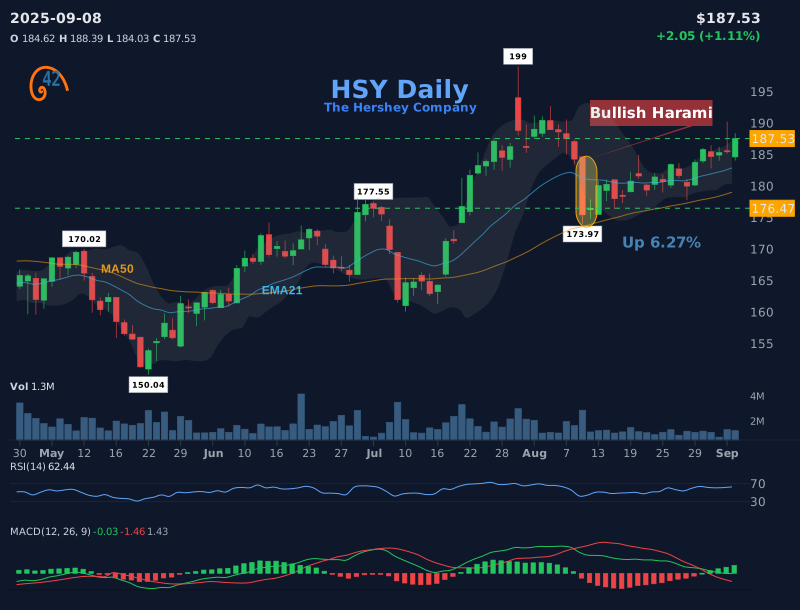
This example illustrates how a common candlestick pattern can gain relevance when it forms above key moving-average support.
The moving average does not signal the trade — it provides the structural backdrop in which the pattern occurs.
2. Holding or Reclaiming Structure After the Pattern
Candlestick patterns do not need immediate follow-through to remain relevant.
What matters more is whether price can hold or reclaim key moving averages in the candles that follow.
Examples of supportive structure include:
- price holding above the EMA 21 after a bullish pattern
- price reclaiming the SMA 50 within a few sessions
- price failing to close back below a key moving average
These behaviors suggest that the market is stabilizing, rather than continuing to break down.
Example: Spinning Top Reclaiming Long-Term Structure ($HCA)
Our scanner identified a Spinning Top in $HCA on 2025-07-25, forming after an extended decline.
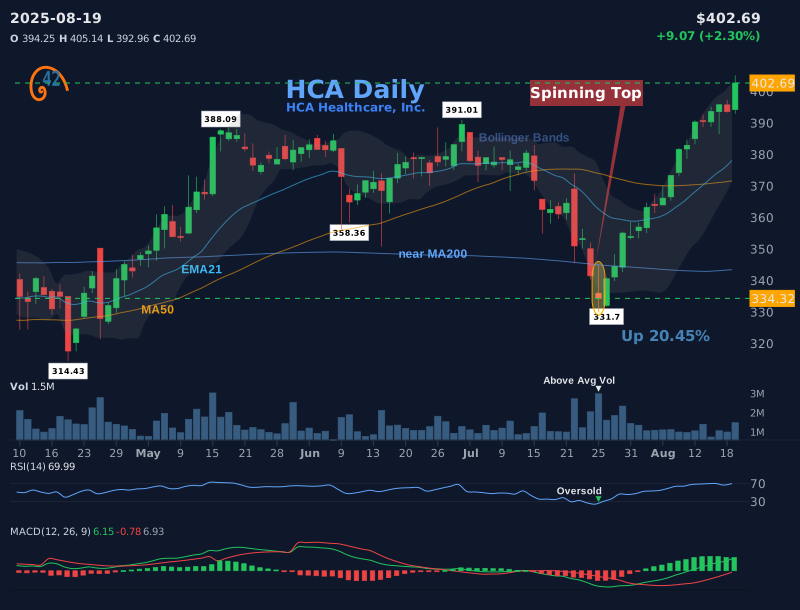
On the signal day, the candle’s long upper wick briefly tested the 200-day simple moving average (SMA 200), indicating early interaction with long-term structure rather than an immediate breakout.
In the sessions that followed:
- price stabilized and reclaimed the SMA 200
- subsequent candles went on to reclaim the EMA 21
- later, price regained the SMA 50
Rather than resolving immediately, the pattern gained relevance as price re-established itself above key moving averages one step at a time.
This example highlights that moving-average context may begin to form during a candlestick pattern and continue to develop in the sessions that follow. What matters is not instant follow-through, but whether price can reclaim and hold important structural levels over time.
A Practical Mental Model
Instead of asking:
“Is this a bullish candlestick pattern?”
Ask:
- What is the trend according to the moving averages?
- Where is price relative to them?
- Is this pattern occurring at a structurally meaningful location?
- Does price respect or reject that structure afterward?
This shift alone eliminates a large portion of low-quality trades.
Final Takeaway
Moving averages do not make candlestick patterns work.
They help you avoid trading the ones that shouldn’t matter.
Candlesticks describe price behavior.
Moving averages define structure.
Used together, they improve trade selection — not certainty.
That distinction is what separates disciplined analysis from pattern chasing.
If you’d like to explore how candlestick patterns behave around key moving-average structures, you can review the following section on 42Fibonacci: