📘 Piercing Pattern
By 42Fibonacci • Last Updated: 2025-12-15 • 7–9 min read
Part of the 42Fibonacci Candlestick Education Series
What Is a Piercing Pattern?
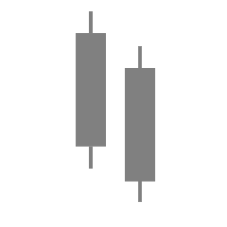
A Piercing Pattern is a two-candle bullish reversal formation that appears after a clear downtrend. It signals that selling pressure may be weakening and that buyers are beginning to reclaim control.
The pattern is defined by two consecutive candles:
- A strong bearish candle that reinforces the ongoing downtrend
- A strong bullish candle that:
- Opens below the prior candle’s low (gap down)
- Closes above the midpoint of the first candle’s real body
This upward penetration — or piercing — into the prior bearish candle reflects a sharp intraday shift in sentiment.
Unlike a Bullish Engulfing Pattern, the Piercing Pattern does not fully overtake the prior candle. Instead, it signals a partial but meaningful reversal, making it an important early indication that bearish momentum may be breaking down.
Origin of the Pattern
The name “Piercing Pattern” comes from the visual appearance of the second candle piercing deeply into the body of the first bearish candle.
This imagery reflects buyers forcefully pushing back against bearish control, reclaiming lost ground within a single session.
The Psychology Behind the Piercing Pattern
The Piercing Pattern captures a dramatic intraday reversal in conviction.
The first candle confirms bearish dominance. Sellers remain confident, pressing price lower and reinforcing negative sentiment. The trend appears intact.
The next session initially supports that narrative. Price opens lower, reinforcing the belief that sellers are still firmly in control.
Then the tone shifts. Buyers step in aggressively, absorbing selling pressure and driving price steadily higher throughout the session. By the close, price has not only recovered the gap but has pushed decisively into the body of the prior bearish candle, closing above its midpoint. This behavior sends a powerful message: sellers were unable to maintain control, and buyers were strong enough to reclaim a meaningful portion of lost ground in a single day.
This sudden change in behavior often triggers:
- short-covering from bearish traders
- renewed interest from value-oriented buyers
- early positioning for a potential trend reversal
The Piercing Pattern reflects bearish momentum breaking down, even though buyers have not yet achieved full dominance.
How to Trade the Piercing Pattern (The Right Way)
Quick read: Use it only after a real downtrend, demand stronger second-bar close above midpoint near support, wait for one confirming bar/volume, and anchor risk to the Piercing low.
The Piercing Pattern is best treated as an early bullish reversal signal, not an automatic entry. Its real value lies in identifying when sellers are losing momentum and buyers are beginning to reclaim control — a transition phase that still requires confirmation.
When traded with patience and confirmation, the Piercing Pattern can serve as a powerful early signal that bearish momentum is breaking down and that a trend reversal may be forming.
Confirm a Meaningful Downtrend First
The Piercing Pattern only has significance when it appears after sustained selling pressure.
- Look for a sequence of lower highs and lower lows
- Multiple bearish candles leading into the pattern
- Evidence that sellers have been in control for more than just one session
Without a clear downtrend, the pattern often reflects short-term volatility rather than a genuine shift in sentiment.
Evaluate the Strength of the Bullish Response
Not all Piercing Patterns carry the same weight.
High-quality setups typically show:
- A strong bullish candle with a large real body
- A close that clearly exceeds the midpoint of the prior bearish candle
- Minimal hesitation near the close, suggesting buyers maintained control into the session’s end
A shallow close just above the midpoint suggests tentative buying, while a deeper penetration reflects stronger conviction.
Use Location as a Confidence Filter
Piercing Patterns are far more reliable when they form near well-defined support zones.
- Prior swing lows
- Demand areas
- Long-term moving averages
- Psychological price levels
When buyers step in aggressively at these areas, it often reflects institutional participation rather than short-term speculation.
Look for Confirmation Before Committing Fully
Because the Piercing Pattern does not fully reverse the prior candle, confirmation is critical.
Traders often wait for:
- A bullish continuation candle following the pattern
- Expansion in volume during or after the bullish candle
- Momentum indicators (RSI, MACD) beginning to turn upward
Confirmation helps separate genuine reversals from one-day countertrend rallies.
Define Risk Using Market Structure
Risk management should be based on the structure of the pattern itself.
Many traders use the low of the bullish Piercing candle as a reference support level.
This low represents the point where buyers successfully defended price after the gap down.
- A sustained break below that low suggests the bullish response failed
- A close back below that level indicates sellers have regained control
If the risk required to trade the pattern is too large relative to reward, the setup may be best avoided.
Case Study: Piercing Pattern at a Downtrend Exhaustion Point
Quick read: After a steady pullback into ~$73 support, $EW printed a Piercing Pattern; buyers reclaimed the midpoint on the gap-down bar and followed with a 6-candle advance.
Timeline
- Late May: Price peaks near $78 again but fails to break higher.
- Late May – Mid June: $EW slides from ~$78 to ~$72, forming a clear short-term downtrend.
- Mid June: A Piercing Pattern prints at support (gap down, close above the prior midpoint).
- Following Sessions: Buyers maintain control, producing a ~10-candle advance.
The Signal
- Gap-down open extended the bearish script.
- Bulls stepped in at support and closed well above the prior midpoint—the defining Piercing trait.
Context
- Pullback from ~$78.30 and formed a clear down trend.
- Location: printed directly on a known demand zone (~$73).
- Depth: bullish bar reclaimed a large portion of the prior loss, not a shallow poke.
- Momentum was fading; RSI drifted toward oversold as price tested that zone.
What Happened
- Sellers never regained control; price climbed for six consecutive sessions, confirming the handoff to buyers.
TIP
Quick checklist: clear prior downtrend, prints at support, close solidly above the midpoint, momentum calming (RSI/MACD), and at least one follow-through bar.
Common Mistakes Traders Make With Piercing Patterns
Quick read: Skipping the midpoint close, trading it in a choppy market with no clear downtrend, entering without confirmation, and ignoring the Piercing candle’s low for risk are the fastest ways to turn it into a false signal.
The Piercing Pattern is often misunderstood because it looks similar to stronger bullish reversals. Most mistakes come from overestimating its strength or ignoring the conditions that give it meaning.
Treating the Piercing Pattern Like a Bullish Engulfing
This is the most common error.
Unlike a Bullish Engulfing, the Piercing Pattern does not show full control shifting to buyers. Sellers are challenged, not defeated. Expecting immediate trend reversal often leads to early entries and disappointment.
The Piercing Pattern signals pressure building, not dominance established.
Ignoring the Midpoint Requirement
The defining feature of the pattern is the bullish candle closing above the midpoint of the prior bearish candle.
If price fails to close above that midpoint, the psychological message changes — buyers pushed back, but not decisively. Many failed Piercing setups occur because this requirement is overlooked or loosely interpreted.
Trading Without a Clear Downtrend
Piercing Patterns are reversal formations. Without prior selling pressure, there is nothing meaningful to reverse.
When the pattern appears after sideways or choppy price action, it often reflects short-term volatility rather than genuine buyer commitment.
Entering Without Confirmation
Because the Piercing Pattern is an early signal, confirmation matters.
Many traders enter immediately after the second candle and get trapped when price stalls or rolls over. Without follow-through, volume support, or structural alignment, the bullish push may be temporary.
Misunderstanding the Role of the Gap
The gap down at the open is part of the psychology — it shows sellers attempting continuation.
However, in modern markets where gaps are less common, traders sometimes force the pattern definition or ignore context. What matters most is the intraday reversal and depth of the bullish close, not the gap alone.
Poor Risk Placement
Some traders place stops arbitrarily, while others ignore structure entirely.
Many experienced traders use the low of the bullish Piercing candle as a reference support level because that low marks the point where buyers successfully absorbed selling pressure after the gap down.
If price closes back below that level, the bullish thesis weakens significantly — a clear signal that sellers may still be in control.
Overconfidence After One Candle
A single Piercing Pattern does not invalidate an entire downtrend.
Without additional confirmation, strong trends can and often do resume. Treating the pattern as proof rather than evidence leads to overconfidence and oversized positions.
Summary: The Piercing Pattern Signals Buyers Are Pushing Back
The Piercing Pattern highlights a moment when sellers lose momentum and buyers aggressively reclaim ground within a single session. It does not signal immediate dominance, but it clearly shows that bearish control is being challenged.
When it appears after a sustained downtrend and near meaningful support, the Piercing Pattern can foreshadow a bullish reversal — provided confirmation follows.
Explore Piercing Pattern setups using our tools:
Treat it as early evidence, not certainty, and let the market confirm the shift.