📘 Engulfing Pattern
By 42Fibonacci • Last Updated: 2025-12-15 • 7–9 min read
Part of the 42Fibonacci Candlestick Education Series
What Is an Engulfing Pattern?
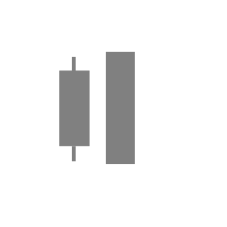
An Engulfing Pattern is a two-candle reversal formation that signals a decisive shift in control between buyers and sellers. It appears when a strong second candle completely engulfs the real body of the previous candle, overpowering the prior session’s momentum.
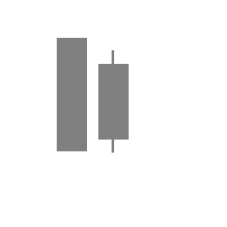
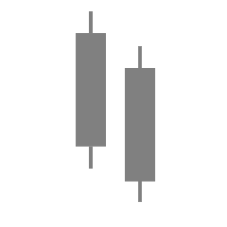
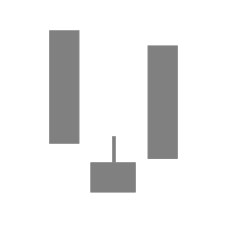
An Engulfing Pattern consists of:
- A smaller first candle, reflecting slowing momentum or hesitation in the current trend
- A larger second candle that fully engulfs the body of the first
- The two candles closing in opposite directions, signaling a transfer of control
There are two primary types:
- Bullish Engulfing — forms after a downtrend and signals potential upside reversal
- Bearish Engulfing — forms after an uptrend and signals potential downside reversal
Unlike single-candle patterns, the Engulfing Pattern stands out because it shows follow-through within the pattern itself, making it one of the clearest expressions of momentum reversal in candlestick analysis.
NOTE
The second candle must engulf the real body, not necessarily the wicks.
The size and close of the engulfing candle matter more than color alone.
Origin of the Pattern
The name “Engulfing Pattern” comes from its distinctive appearance. The second candle’s body completely engulfs the body of the first candle, visually demonstrating the overpowering force of the new direction.
The Psychology Behind the Engulfing Pattern
The Engulfing Pattern captures a sudden and forceful reversal in conviction.
The first candle reflects hesitation. The prevailing side — buyers in an uptrend or sellers in a downtrend — is still in control, but momentum is weakening. Participation fades, and conviction softens.
The second candle changes everything.
The opposing side enters aggressively, overwhelming the prior session’s range and erasing the previous candle entirely. This is not a quiet transition — it is a takeover. The market does not merely pause; it reverses with intent.
- In a Bullish Engulfing, sellers attempt to continue the decline but are met with strong buying that pushes price decisively higher.
- In a Bearish Engulfing, buyers attempt to extend the rally but are overwhelmed by selling pressure that drives price sharply lower.
By the close of the engulfing candle, control has clearly changed hands. This is why the Engulfing Pattern is often associated with trend inflection points rather than simple pauses.
How to Trade the Engulfing Pattern (The Right Way)
Quick read: Use it after a real trend, demand a decisive engulfing body near key support/resistance, seek follow-through with volume/momentum, and set risk beyond the engulfing candle’s extreme.
The Engulfing Pattern is one of the clearest visual signals of a momentum shift, but it still requires proper context to be traded effectively. Its reliability comes from where it forms, how strong the engulfing candle is, and whether the market follows through — not from the pattern alone.
Start With Trend Context
Engulfing Patterns work best after a clear directional move.
- A Bullish Engulfing is most meaningful after a sustained downtrend, where selling pressure has already been established.
- A Bearish Engulfing carries more weight after a prolonged uptrend, where buying momentum may be weakening.
Without prior trend pressure, an engulfing formation often reflects short-term volatility rather than a true reversal.
Evaluate the Quality of the Engulfing Candle
Not all engulfing candles are equal. High-quality setups usually share a few characteristics:
- The engulfing candle has a large real body relative to recent candles.
- It fully engulfs the prior candle’s body, not just by a small margin.
- The candle closes near its high (bullish) or near its low (bearish), showing conviction rather than hesitation.
Weak engulfing candles with long opposing wicks or small bodies are more prone to failure.
Pay Attention to Location
Where the pattern forms often matters more than the pattern itself.
- Engulfing Patterns near support or resistance tend to be far more reliable.
- Prior highs, lows, consolidation zones, or key moving averages often act as natural inflection points.
- Patterns forming in open, structureless areas of the chart are easier for the market to fade.
Look for Confirmation
Although the Engulfing Pattern already includes a momentum shift, additional confirmation can improve reliability.
- Continued price movement in the direction of the engulfing candle
- Rising volume during or after the pattern
- Alignment with momentum indicators such as RSI or MACD
These signals help confirm that control has genuinely changed hands.
Define Risk and Invalidation
Every engulfing setup needs a clear failure point.
- For a Bullish Engulfing, a close back below the engulfing candle’s low weakens the bullish thesis.
- For a Bearish Engulfing, a close above the engulfing candle’s high invalidates the bearish setup.
Common Mistakes Traders Make With Engulfing Patterns
Quick read: Trading “engulfs” without trend, accepting tiny/technical engulfs, focusing on wicks instead of bodies, ignoring location, skipping confirmation in chop, mis-sizing stops on big candles, or assuming every engulfing is high probability.
Engulfing Patterns look obvious on a chart, which is exactly why they are often over-traded. Most failures come from treating the pattern as a guaranteed reversal instead of what it really is: evidence of a potential shift in control that still needs context and validation.
Trading Engulfing Patterns Without a Real Trend
Engulfing Patterns are reversal formations. If price has been moving sideways, there is no meaningful trend to reverse, and engulfing candles often appear as random noise. A Bullish Engulfing after a flat range is not the same as a Bullish Engulfing after sustained selling pressure.
Overvaluing “Tiny Engulfs”
Many traders label a pattern “engulfing” even when the second candle barely covers the prior body by a small margin. These marginal patterns often lack conviction and fail more frequently. A strong engulfing candle should feel like a decisive takeover, not a technicality.
Confusing Wick Engulfing With Body Engulfing
The definition is based on the real body, not just the full high/low range. Wicks can expand due to volatility and do not necessarily represent control. If only the wicks overlap while the body does not engulf, the signal is weaker and often misclassified.
Ignoring Location (Support/Resistance)
An Engulfing Pattern forming in open space is far easier for the market to fade. Patterns that print near prior highs/lows, demand/supply zones, or key moving averages often carry more meaning because they occur where traders are already watching for a reaction.
Entering Without Confirmation in Choppy Conditions
Engulfing Patterns include internal momentum shift, but in choppy or volatile markets they can still be “one-day events.” Without follow-through (or without additional confirmation such as volume expansion), traders can get trapped as price snaps back into the prior range.
Using Stops That Don’t Match the Candle’s Size
Engulfing candles can be large. Traders often either:
- place stops too tight (getting stopped out by normal fluctuation), or
- place stops too wide (taking poor risk/reward trades)
The pattern must be traded with realistic sizing and risk planning. If the candle is too large to manage safely, it may be a setup to skip.
Treating Every Engulfing as “High Probability”
Engulfing Patterns are common. What makes them high-quality is not the label — it’s the surrounding evidence:
- clear trend pressure beforehand
- strong close near the candle’s extreme
- meaningful level interaction
- volume participation
- follow-through afterward
Without these, the pattern may be visually correct but strategically weak.
Summary: When Control Flips, Momentum Often Follows
The Engulfing Pattern is one of the clearest two-candle signals of a shift in control. A smaller first candle shows fading momentum, and the second candle’s decisive engulfing body reflects a sudden takeover by the opposing side.
When an Engulfing Pattern appears after a clear trend and near meaningful levels, it can foreshadow an important reversal — not because it predicts the future, but because it reveals when the market has changed hands.
The best results come from treating the pattern as evidence, not a guarantee: prioritize trend context, candle quality, key levels, and follow-through, and always define risk.
Explore Engulfing Pattern setups using our tools:
When conviction flips, pay attention — and let confirmation guide the trade.