📘 How to Trade Candlesticks With Volume
By 42Fibonacci • Last Updated: 2025-12-19 • 10–12 min read
Part of the 42Fibonacci Candlestick Education Series
Introduction: Why Candlesticks Alone Are Not Enough
Candlestick patterns show how price moved — but they do not tell the full story on their own.
If you’ve read our guide on Candlestick Charts: The Complete Beginner’s Guide, you already understand how candle bodies and wicks reflect the ongoing battle between buyers and sellers. That foundation is essential. But to trade candlesticks with consistency, one more ingredient is critical:
Volume.
This article builds on your candlestick knowledge and focuses on how traders combine price action with volume analysis to separate meaningful signals from noise. Rather than repeating candlestick definitions, we’ll explore how volume adds context, conviction, and confirmation to what candles are already telling you.
What Is Volume
Volume represents the number of shares or contracts traded during a specific time period. That period can vary depending on trading style:
- Intraday traders may analyze volume by the minute or hour
- Swing and position traders most commonly focus on daily volume
- Longer-term investors may also reference weekly volume
In this article, we focus specifically on daily volume, as it is the most relevant timeframe for evaluating daily candlestick patterns.
Absolute Volume: The Raw Activity Level
The most basic way to view volume is by its absolute number — how many shares trade in a day.
For example:
- A low-liquidity stock may trade 50,000 shares per day
- A highly liquid large-cap stock like $AAPL may trade 50 million shares per day
Both stocks can form identical-looking candlesticks, but the trading environment behind those candles is very different. Absolute volume helps traders understand liquidity, stability, and the likelihood that a price move can sustain follow-through.
Average Volume: Defining What Is “Normal”
Raw volume becomes meaningful only when compared to a stock’s typical trading activity. For this reason, traders use average volume as a baseline.
Average volume is calculated over a fixed lookback period, such as:
- 10-day average volume — short-term activity
- 20-day average volume — standard daily baseline
- 50-day average volume — longer-term context
In daily candlestick analysis, the 20-day average volume is most commonly used. It captures roughly one trading month and smooths out one-off spikes or unusually quiet sessions.
Relative Average Volume: Measuring Participation
Relative average volume compares today’s volume to the stock’s average volume over a chosen lookback period.
It answers a simple question:
Is today’s trading activity unusually high or unusually low compared to normal?
For example:
- A stock with a 20-day average volume of 1M shares
- trading 2.5M shares today → 2.5× relative average volume
- A stock with a 20-day average volume of 50M shares
- trading 20M shares today → 0.4× relative average volume
This allows traders to evaluate volume consistently across stocks of different sizes and liquidity levels.
Throughout this article, when we refer to high volume or low volume, we are referring to volume relative to the 20-day average, unless stated otherwise.
Interpreting High and Low Relative Average Volume
As a general guideline:
- > 1.5× 20-day average volume → elevated participation
- > 2.0× 20-day average volume → strong participation
- < 0.8× 20-day average volume → below-normal participation
When a candlestick pattern forms on above-average relative volume, the price move reflects broader market engagement. When it forms on below-average volume, the signal is more likely to lack follow-through.
Why Volume Changes Everything
Candlesticks describe price behavior — where price opened, moved, and closed.
Volume adds a second dimension: how much participation supported that price movement.
A bullish candle, for example, can form under very different conditions:
- High participation: many market participants actively traded in the same direction
- Low participation: price moved because few traders were involved and liquidity was thin
On a chart, these candles may look identical. But the probability of follow-through is not.
Price Alone Is Incomplete Information
Price tells you what happened during the session, but not how difficult it was for the market to move there.
A large green candle formed on:
- above-average volume suggests the move required broad engagement
- below-average volume suggests the move faced little resistance
Without volume, both scenarios appear identical — yet their implications for risk and continuation are very different.
Volume as a Filter for Candlestick Patterns
This is why experienced traders rarely evaluate candlestick patterns in isolation.
Volume acts as a filter, helping traders separate meaningful price behavior from background noise.
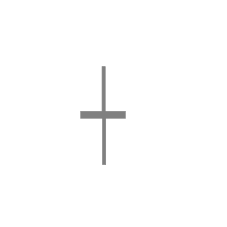
This filtering effect is especially important for common patterns like the Doji.
The Doji is one of the most frequently occurring candlestick patterns in the market. Because it simply reflects open and close prices near the same level, most Doji candles carry little significance on their own.
Volume helps distinguish which Doji matter.
Consider a Doji that forms after an extended downtrend:
- A Doji on below-average volume often represents temporary balance or indecision, with no meaningful shift in participation.
- A Doji forming on 2.5× the 20-day average volume tells a different story.
In the high-volume case, price attempted to move lower but met unusually strong opposing participation, resulting in a narrow close. The Doji formed not because trading was quiet, but because active buying absorbed ongoing selling pressure.
This does not guarantee a reversal. However, it elevates the Doji from routine noise to a high-conviction observation — a point where the market demonstrated engagement rather than indifference.
What Volume Does (and Does Not Do)
Volume does not predict direction, guarantee outcomes, or explain trader intent.
Its value lies in providing context:
- highlighting when participation is unusually high or low
- helping traders focus on higher-quality setups
- reducing attention paid to patterns formed in thin or inactive conditions
Used this way, volume improves signal quality, not certainty.
How Volume Confirms Candlestick Signals
Volume does not create candlestick signals — it evaluates them.
Candlestick patterns describe how price behaved within a session. Volume helps determine whether that behavior occurred during normal conditions or during unusually active participation. When volume aligns with a candlestick signal, the signal carries more weight. When it does not, caution is warranted.
Below are the most common ways volume confirms candlestick patterns in daily trading.
1. Above-Average Volume on the Signal Candle
The most direct form of volume confirmation occurs when a candlestick pattern forms on above-average relative volume.
When volume expands into the signal candle, it suggests the market actively engaged at that price level. The move was not quiet or incidental — it required unusually strong participation.
This type of confirmation is especially relevant for:
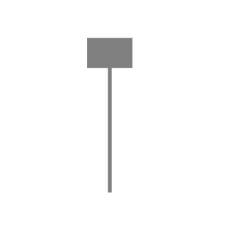
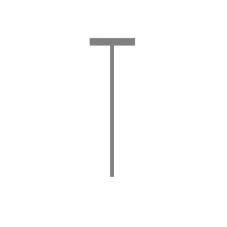
- reversal patterns (Doji, Spinning Top, Hammer)
- single-candle inflection signals after extended trends
Example: Spinning Top with Above-Average Volume ($HCA)
Our scanner identified below Spinning Top in $HCA on 2025-07-25, forming after an extended decline.
What made this candle noteworthy was not its shape alone, but its volume context:
- Trading volume expanded to well above the 20-day average
- The candle formed near the later stage of a sustained downtrend
- Despite intraday volatility, price closed near its opening level under heavy participation
This combination suggests that the market actively traded at that level rather than drifting through it.
Following this candle, price reversed without hesitation, transitioning into a bullish move. While no single candle guarantees an outcome, the elevated volume helped distinguish this Spinning Top from the many low-impact versions that form during routine trading.
This is a practical example of how above-average volume can elevate a common candlestick pattern into a high-quality signal worth attention.
2. Volume Supports the Follow-Through Candle
Candlestick patterns are rarely complete with a single candle. What happens next matters.
A common confirmation sequence looks like this:
- signal candle forms on elevated volume
- the following candle closes in the expected direction
- volume remains at or above average
This tells you the initial signal did not immediately lose attention.
Conversely, when volume collapses on the follow-through candle, even a strong-looking pattern may stall.
Example: Bullish Harami Cross with Follow-Through Volume ($NEE)
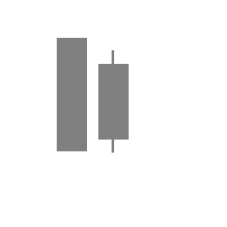
Our scanner identified a Bullish Harami Cross in $NEE on 2025-09-17, forming after an extended decline.
What made this setup noteworthy was how volume behaved after the pattern formed:
- The Harami Cross appeared on approximately average volume
- The first follow-through candle closed above the Doji with slightly higher participation
- The second follow-through candle showed a clear expansion in volume as price continued higher
Rather than spiking immediately, volume built progressively, indicating that the market did not ignore the pattern. As direction became clearer, participation increased in support of the emerging bullish move.
This is a practical example of how volume confirmation can occur during follow-through, reinforcing a candlestick signal even when the initial pattern does not form on unusually high volume.
Final Thoughts: Using Volume as Context, Not a Trigger
Candlestick patterns provide structure — they show how price behaved within a session.
Volume provides context — it shows how much participation supported that behavior.
Used together, they help traders focus on higher-quality signals rather than reacting to every candle that appears on a chart.
Volume does not predict direction or guarantee outcomes. Its value lies in filtering: highlighting when price action occurred under unusually active conditions and when it formed quietly without follow-through.
For daily candlestick trading, treating volume as a confirmation and quality filter, rather than a standalone signal, leads to more disciplined analysis and better decision-making.
If you’d like to see how elevated volume appears across different candlestick patterns, explore the following sections on 42Fibonacci: