42FibonacciLogo

42Fibonacci

📘 Candlestick Charts: The Complete Beginner’s Guide

By 42Fibonacci • Last Updated: 2025-12-10 • 7–9 min read
Part of the 42Fibonacci Candlestick Education Series

What Is a Candlestick Chart?

Candlestick charts—sometimes called “K-Charts” (with K meaning candlestick in Japanese)—are one of the most widely used ways to visualize price movement in technical analysis. Each candlestick represents how a stock behaved during a specific time period, whether that’s one minute, one hour, or one day.

Every candlestick contains four important prices, collectively known as OHLC:

  • Open — the price at which the period began
  • High — the highest price reached
  • Low — the lowest price reached
  • Close — the final price when the period ended

The distance between the open and close forms the body, while the price extremes above and below the body create the upper and lower wicks (also called shadows). These elements make candlesticks far more informative than simple line charts because they show the full range of trading within that period.

  • When the closing price is lower than the opening price → the candle is bearish (typically filled).
  • When the closing price is higher than the opening price → the candle is bullish (typically empty).

Because candlesticks clearly show where price moved, where it reversed, and how the session finished, they have become the foundation for many pattern-based trading strategies. They also form the basis of how our 42Fibonacci Scanner interprets and highlights candlestick patterns.

Basic Candlestick Diagram
Basic candlestick anatomy: open, high, low, close with upper and lower wicks.

NOTE

  • A filled/black/red body typically indicates bearish sentiment.
  • An empty/white/green body indicates bullish sentiment.
  • A shaved head means no upper wick — strong bullish momentum.
  • A shaved bottom means no lower wick — strong bearish momentum.

The Psychology Behind Every Candle

Quick read: Bodies show who controlled the session; wicks reveal where control was challenged or rejected; long wicks = failed pushes, no wicks = dominant drive; context around prior move/level decides whether the “battle” matters.

Every candlestick represents a miniature battle between buyers (bulls) and sellers (bears). The shape of the candle—its body size, wick length, and position relative to recent price action—reveals the emotional footprint left behind by this battle.

Understanding this psychology turns candlestick reading from simple pattern recognition into meaningful market interpretation. Candle behavior reveals who is gaining or losing control, where momentum is shifting, and whether the market is rejecting or accepting key price levels — all of which are critical signals that experienced traders and the 42Fibonacci Scanner evaluate before highlighting a meaningful setup.

Candle Body Psychology

The body of a candlestick shows who controlled the session and how strong that control was.

Candle TypePsychological Meaning
Long Bullish BodyBuyers dominated from open to close; strong momentum; confidence and urgency from bulls.
Long Bearish BodySellers controlled the entire session; fear, capitulation, or aggressive selling pressure.
Small BodyNeither side had conviction; equilibrium; often appears before breakouts or reversals.

These body structures reveal the intensity of the battle between bulls and bears.


Wick (Shadow) Psychology

Wicks represent price extremes and show how aggressively buyers or sellers tested the market during the session.

Wick BehaviorInterpretation
Long Upper WickBuyers pushed the price upward, but sellers overwhelmed them — bearish rejection.
Long Lower WickSellers drove price down, but buyers absorbed the move and forced it back up — bullish rejection.
Long Wicks on Both SidesHigh volatility, indecision, and aggressive attempts from both camps; often precedes major moves.
No WicksA candle with no shadows — price moved straight up or straight down all session. Shows strong conviction from one side.

Wick behavior is one of the clearest visual clues of rejection, absorption, and hidden strength.

How to Trade Candlestick Patterns (The Right Way)

Quick read: Align patterns with trend and key levels, demand volume/structure confirmation, use multi-timeframe agreement, and define risk/invalidation before acting — candles are context clues, not standalone triggers.

Candlestick patterns are powerful tools, but they should never be traded in isolation. A candle can look picture-perfect yet still fail if the surrounding market environment doesn't support the signal. Experienced traders treat candlesticks as context clues, not standalone buy or sell triggers.

Trend Context Matters

Candlestick patterns gain meaning only when aligned with the prevailing trend.

  • A bullish reversal pattern carries more weight after a well-defined downtrend, where sellers have already shown signs of exhaustion.
  • A bearish pattern becomes meaningful after a persistent uptrend, where profit-taking or weakening momentum is plausible.
  • Patterns inside a sideways or choppy range tend to be weaker because neither side has clear control.

Trend context is one of the strongest filters used by professional traders.


Support and Resistance Levels

The effectiveness of a candlestick pattern often depends on where it forms.

  • Bullish patterns at support zones (previous lows, demand clusters) are more reliable.
  • Bearish patterns near resistance levels (previous highs, supply zones) carry stronger credibility.
  • A reversal candlestick forming in the “middle of nowhere” is usually just noise.

Location is often more important than the pattern itself.


Volume Confirmation

Volume acts as a lie detector for price action.

  • A strong candle supported by elevated relative volume suggests genuine conviction.
  • A dramatic candle on low volume may simply reflect thin liquidity or temporary fluctuations.
  • Volume spikes around support or resistance often validate the strength of a reversal or continuation pattern.

Without volume, even the cleanest candlestick can be misleading.


Multi-Timeframe Alignment

Higher timeframes establish the macro structure that governs lower-timeframe behavior.

  • A bullish candle on the daily chart is more reliable when the weekly chart also supports the move.
  • A bearish pattern on the 1-hour chart is stronger when the 4-hour or daily trend is weakening.

This approach — known as top-down analysis — greatly increases the probability that the signal aligns with the broader market narrative.

IMPORTANT

Candlestick patterns do not guarantee outcomes. Always use proper risk management.

Case Study: Bullish Harami Cross (AEP)

Quick read: After sliding from ~$115 into ~$107 support, $AEP printed a gap-up doji fully inside the prior red body; that pause in selling turned into a ~10-bar advance.

Bullish Harami Example
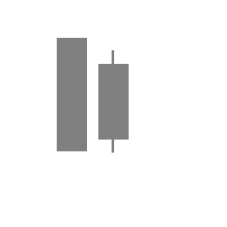
Bullish Harami Cross on $AEP: a gap-up doji contained inside a strong bearish candle, signaling fading selling pressure.

Timeline

  • Late July: Peaks near ~$115.
  • Early Aug – Mid Sep: Multi-week slide into ~$107 support.
  • Mid Sep (signal day): Gap-up doji sits fully inside prior red body → Bullish Harami Cross.
  • Following sessions: Buyers sustain a ~10-candle advance.

The Signal

  • After a strong red candle, price gapped up and formed a doji entirely inside the prior body — classic Harami Cross and a clear pause in bearish follow-through.

Context

  • Extended multi-week downtrend from ~$115 to ~$107.
  • Pattern printed right at the defined support area near ~$107.
  • Momentum was slowing; RSI near oversold; MACD turning up.

What Happened

  • Bears couldn’t reassert; buyers stepped in and AEP climbed for roughly 10 sessions, confirming the handoff.

TIP

Quick checklist: real prior trend, tiny inside candle (doji ideal), forms at support/resistance, midpoint respected, and at least one follow-through bar.

Common Mistakes Traders Make With Candlesticks

Quick read: Acting before the candle closes, skipping invalidation, overreacting to single candles without structure/volume, ignoring volatility regime, or trading without a risk plan.

Many traders understand candlestick patterns but still struggle to use them effectively in real market conditions. Most candlestick failures happen not because the pattern is inaccurate, but because the surrounding conditions — risk, volatility, confirmation, and discipline — were ignored. Understanding these pitfalls helps traders interpret patterns more realistically and use them more effectively.

Entering Too Early

A candle can look convincing while it is forming but fail by the close. Early entries based on partial information often lead to being shaken out by normal volatility.

Ignoring Invalidation Levels

Every candlestick setup has a point where the idea is no longer valid. Traders often hold losing trades because they become emotionally attached to the pattern.

Overreacting to Single Candles

One dramatic candle does not change the entire trend. Without confirmation from structure and follow-through, a single candle can be misleading.

No Risk Management

Even the cleanest, most textbook patterns fail. Without a stop-loss, position sizing plan, or defined risk, small losses can turn into large ones quickly.

Treating All Markets the Same

Candles behave differently in high-volatility vs. low-volatility environments. A doji in a calm market may signal indecision, while in a fast market it may simply reflect noise. Volatility defines meaning.

Summary: Candlesticks Are a Language — Learn to Read Their Story

Candlestick charts reveal the ongoing dialogue between buyers and sellers. When combined with context, volume, and trend structure, they become a powerful tool for reading market intention.

Explore candlestick setups using our tools:

👉 Candlestick Pattern Scanner
👉 Daily High-Volume Candlesticks
👉 Daily Near-MA Candlesticks
👉 Daily Oversold Candlesticks

Start learning how individual candles shape market decisions — and how they can shape yours.